Music Videos, 80s and Beyond

Uncategorized

The Auto-Eroticism of Fountains of Wayne’s “Denise” Video

Fountains of Wayne, “Denise”

Fountains of Wayne first hooked me with their masterpiece concept album, Utopia Parkway, an ode to the also-ran early adults who smoked pot in the back of vans, went to coffee-house shows at Barnes & Noble, listened to Korn. The album captures the lives of those who never quite grew up—just self-aware enough to recognize their own stagnation but cushioned by privilege to avoid real consequences. They drift but never crash.

That sense of middle-ground nostalgia should have translated into breakout sales, but somehow it didn’t. Utopia Parkway had all the ingredients: sharp storytelling, airtight hooks. It was clever without being smug, accessible without pandering. And yet, it scattered into fan-boy appreciation rather than mainstream success—perhaps too middle-class to feel urgent, too polished to be rebellious.

The one official video from the album was the sublime “Denise,” a song that never charted outside of the alt list but, in retrospect, prefigured their only real hit, “Stacy’s Mom.” The difference between the two was mostly novelty marketing. “Stacy’s Mom” had a built-in high-concept premise: a teenage boy infatuated with his friend’s mom. “Denise,” by contrast, plays it straight—an impossible longing for an unattainable love object (and her lavender Lexus), a theme that runs through much of FOW’s best work. Both songs hinge on that same core emotional hook, but “Stacy’s Mom” had a music video that played up the comedy in a way that made it easy to package for early-2000s MTV.

And yet, Denise might be the more interesting of the two. The video, at first glance, leans into familiar rock tropes—a foxy love interest, an adoring band, stylized excess. The fact that FOW have two videos where a woman is getting the Flashdance shower treatment makes you wonder if they are fracking the male gaze, and are indeed nice-guy frat rock. But “Denise” quickly subverts this supposition. It’s not that the video muse Denise is too unbelievably hot for the band (though, in reality, she is), and can only be ‘had’ in the form of a teenage boy fantasy of her getting drenched—it’s that she only has eyes for her car, her “lavender Lexus.”

There are shades, lavender shades, of J.G. Ballard’s novel, Crash, in which characters are romantically attracted to car crashes. Denise’s love affair with her Lexus isn’t just a visual gag—it taps into something deeper, a pop-friendly nod to the auto-erotic obsession found in Crash. In “Denise,” the romance is streamlined and sanitized, but the DNA of that fetish remains. It also feels like a sly nod to The Cars, the band Fountains of Wayne most resembles, and who might have been the blueprint for the career they should have had.

J.G. Ballsrd´s Crash

But they didn’t have that career. Fountains of Wayne will forever be, to my mind, the most deserving/least appreciated band of my generation. Their songs, one after the other, are gems of ear toffee, falling just short of anthems and perfect for so many film and TV soundtracks they somehow never landed. They were tailor-made for the angst of suburban summers, for the peculiar youthful restlessness of places like Montclair, Scarsdale, and Winnetka.

Maybe they were just too Upper Middle Class, the survival instinct buried under Enteman’s cookie packaging and Nintendo games. This was before Vampire Weekend made liberal arts slumming cool—or their version of cool. Also, there’s nothing cool about Vampire Weekend.

Ultimately, FOW were smarter than they were dangerous, and you might put their lack of success down to their lack of charisma. They looked like what they were: a pair of nice guys from Williams College who could have just as easily been humanities professors, copyright lawyers, or publishing executives as rock stars. It’s a tough act to pull off. Hence, the mythologizing, sexualized videos that are highly referential to ‘cooler’ art and artists.

All this sounds like I don’t like FOW, but when all is said and done, I identify with them more than any pop artists outside of other New England liberal arts college grads like Elliott Smith. Their world—their sound, their sensibility—is one I know all too well. Maybe that’s why it never quite hit. It wasn’t a fantasy. It was just… familiar.

Video for Fountains of Wayne´s Denise

More on suburban woe in my memoir, Strange as Angels, here, live on PDF.

Or, sample this semi “Denise” inspired Playlist.
Uncategorized

Pin Kode: Ariel Pink’s Picture Me Gone

“Picture Me Gone” video / Ariel Pink

I didn’t think much of Ariel Pink until his triptych of videos from the 4AD-released album pom pom started showing up on YouTube. All directed by Grant Singer, they offered a hook into the artist whose recordings can be challenging. But the lush visuals and narratives of Los Angeles misfits make them hard to turn away from—more arthouse noir films in miniature than music videos. Soon, the songs themselves became the craving.

I think of the video to “Picture Me Gone,” in particular, as a time-release capsule; a slow revelation of greatness, which doesn’t just sit in the mind but leaves graffiti on the psychological landscape that only comes clear once you’ve passed it by. It’s easy to dismiss the video, and Pink himself, as a weird outlier until you stop and engage.

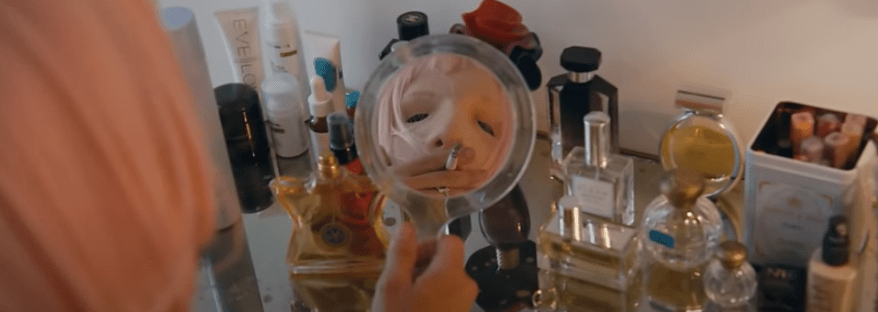
The storyline imagines the lives of three latex-masked loners in Los Angeles, their faces featureless, blank canvases the viewer can project onto. It’s creepy in a Twilight Zone way, both hip and mundane—a reality show of Michael Myers’ urbane relations and their erotic lives. It has an otherworldly quality, a horror movie devoid of overt horror, which is not so different from how Los Angeles actually feels.

The motifs of the uncanny contribute to a work that’s disembodied of meaning but also impossible not to interpret. All at once it might be about gender fluidity, erosion of identity, alienation, abortive attempts at connection, or possibly something entirely different, as the bare nipple pointed at the thirsty housecat would imply—an aesthetic I’m calling ‘dark cozy.’

The sunny, atmospheric video saves the song from all the suicide ideation one could bring to the tantalizingly bleak lyrics. Which begs the question: do we want to be saved? Pink will never be a comfort-listen, and the few swoony ballads like “Picture Me Gone” are outliers in his oeuvre. Mediated death and mimetic suicide always have their comforts, and are one reason artists who kill themselves skyrocket in popularity.

But Pink’s not that kind of artist. He is more remote, cloistered, contrary, and unrestrained. He’s a flasher throwing open his overcoat and accosting you with taxidermy badgers, Zippy the Pinhead comic strips, the likeness of Santa Muerte burnt into toast. His vibe is Dadaist, more in the vein of The Fall and Kurt Weill than his stated influences would suggest. Though maybe in his exuberant need to provoke, and to refuse to let you in on the joke, along with his relentless creative outpouring, Kanye West is his closest ally. Like Ye, he does so little to court favor, to be liked, which is in contrast to depressive musicians of his generation—Elliott Smith, for example—whose misery seems to yearn for company, understanding, and empathy.

Like David Lynch, who mined and then introduced us to our common dreamscapes, Pink doesn’t drape his work in melancholy. What’s beneath it all is a sincerity that belies the irony one expects of artists of his generation. It’s the unguarded selfie posted just to know somebody is looking, even if it’s only the camera, our pictures increasingly a stand-in for our personalities. Maybe imagining losing your iPhone is a kind of suicide ideation.

According to Pink, the song is about the modern condition of having all your memories locked inside a smartphone, without analog versions to preserve them. If you die without sharing your passwords, what remains of you? What if your device is lost—“down in Mexico”? But there’s something more personal at work here. Pink’s own past in Mexico—sent to live with relatives to escape high school bullying, and losing his virginity to a prostitute at thirteen—adds another layer. The song carries echoes of an ’80s sex comedy about loss of innocence as much as it critiques the fragility of digital memory.

The lyrics “Picture me gone / Picture me gone/ Picture me not” present the audience with a nifty zen koan, as you can’t picture something that’s not there; an Instagram account curating the void. Yet he’s not requesting that the listener contemplate this; he’s commanding them. Fittingly, Pink was canceled by people who mistook his artistic outsider tendencies as political affinities and then felt betrayed when this proved wrong. Moreover, the “Picture Me Gone” video and equally pathos-filled “Dayzed Inn Daydreams” come and go from YouTube, so like their creator. Pink’s mode is to be missed, to be present when not there. Pink asks the question: without our selfies, our social media accounts, do we exist at all, and what will be remembered of us when they are deactivated or locked? Pics or it didn’t happen. But what if the pics disappear as well?

Ariel Pink, “Picture Me Gone”

Picture Me Gone playlist

Robert Smith and all the undead 80s, here in my memoir Strange as Angels