Uncategorized

Magdalena Bay’s “Image” Video and the Art of the Uncanny

Drawing by Leonora Carrington

Since their inception, Magdalena Bay have been enthusiastic and discerning world builders. Like magpies, they’ve gathered fragments of diverse musical tropes, Internet culture, and the nostalgia of previous generations. Over time, they’ve assembled an aesthetic that is now all their own, to the point where their influences no longer feel curated but sublimated into an aesthetic that’s at once digestible, delectable, and erudite.  

The duo of Mica Tenebaum and Matt Lewin hides their virtuosity in plain sight. The music feels effortless, like vivid prose writing. Think of the difference between Haruki Murakami’s simple sentences and the discipline he exerts on them, and those of hack horror or genre writers. This isn’t to say Magdalena Bay is simple, but the synth-pop idioms they work in just don’t historically hold the gravitas as, say, jazz. But genre is just a conduit for their creative brilliance—they shapeshift with each listener, and you can also appreciate them solely as a party band.

As their confidence and ambition grew, their visuals likewise evolved. Before their breakthrough album Imaginal Disc, Matt and Mica created their own music videos—clever, home-grown works that suggested they could’ve just as easily attended art school as music school. “Secrets (Your Fire)” in particular is a pastiche of vaporwave aesthetics and Gen-X nostalgia (they make the Miami Vice color palette pop like they invented it). Only with the Imaginal Disc singles did they hand over directing duties, and the videos became less personal projects and more promotional tools. Yet they remained rich with meaning.

Foremost among them is “Image,” directed by Please Baby Please film-maker Amanda Kramer. It’s unsettling if not horrific. And not in the “Everlong” tongue-in-cheek way (the Foo Fighters could never get away with the layered meanings Magdalena Bay bring to a track and video). Mica—the exuberant vocal half of the pair—playing a character named True, is menaced, snipped at, and actually cut up by a robed star god/cosmetologist on one hellacious spa day. Anyone who has been chased in a dream and felt their limbs go sluggish and non-reactive (and I assume this is most people) will recognize the claustrophobic dread that is amplified by the dream state. Mica’s diminutive frame only heightens the sense of menace as she flees across a cosmic, hyper-synthetic nightmare. And he’s just so big, compared to the singer. This is a change from the usual dynamic, where Mica is riding dragons, beating down Clippy widgets, or breaking the fourth wall with a wink.

But as much as adding depth to a dance song, the video has captured what literary critics call ‘the uncanny.’ The uncanny lives in that liminal space where the familiar turns strange, where reality warps just enough to induce dread. It can range from the works of Murakami to Aimee Bender, Leonora Carrington, and, some say, Kafka. It is the commonplace waiting room of “Image” that turns into a showcase for Eraserhead extras, whose carved-into-flesh smiles come off more as mutations than expressions, radiating the menace in the mundane.

The video is propulsive, and there’s little room to breathe. In her quest to ‘upgrade’ her image, True offers, sacrificially almost, her stylized dancing, and you can enjoy the grammar of sex appeal, though the underlying message is one of threat and conformity, with the singer as a willing final girl. Sex and death are forever the deepest drivers of our dreamscape, no matter the genre.

It’s fitting, then, that the next track on Imaginal Disc is “Death and Romance.” Matt and Mica clearly understand more than how to drop a single—they understand how to build an album. Imaginal Disc might be the first-ever synth-pop concept album. The sequencing matters—almost quaintly so—and yet the songs still stand alone. Like any great concept album, its parts cohere without sacrificing independence.

Ultimately, in “Image” and Imaginal Disc, there’s an intimate menace at work in the duo’s vision, one that fracks the depths of an ambitious vinyl collection. It’s pop that transports, yet remains grounded. In the end, Magdalena Bay is more wormhole than rabbit hole, blowing you away while leaving you standing on your feet.

Magdelina Bay, “Image”

I write more on the uncanny in my memoir, Strange as Angels, here on Kindle, or download Strange as Angels free, live on PDF. Are you sure you want to know?

My playlist for this post, Imaginal Desk.

peerfume genius and Arpad Miklos
Uncategorized

Perfume Genius’s “Hood” Video and the Freedom of Exposure

It’s easy to focus on the sensational aspects of the Perfume Genius video for their 2013 single “Hood.” There are a lot of them. Foremost, the banning of the advertising clip for the video by YouTube made news outlets from Pitchfork to the Huffington Post. While the subsequent outrage and charges of institutional homophobia failed to get it reinstated, the publicity amplified the video’s reach. Then there’s the semi-nude appearance of beefy Hungarian porn star (and chemist!) Arpad Miklos, who would commit suicide in New York City soon after the video’s release.

“Hood” landed in my life at a time when I, too, felt unrecognizable to myself. I came to this song during one of the most challenging periods of my life: a winter when I was having daily panic attacks, which persisted for months. It was the beginning of what would be a long and dark Central European winter, a place where the sun seemed to fall faster and more definitively than in my former home of Brooklyn. When the sun goes down on a Budapest winter, you feel less certain it will rise again, as though it simply called it quits. Because I’d stopped socializing and going out, for the most part, I used media as a window to the world, and videos like “Hood” became reflections to locate myself within.

Perfume Genius, and the emotional forensics Mike Hadreas brings to their music, became part of my survival mechanism. Alongside red wine, Xanax, and no shortage of music, “Hood” and “Dark Parts”—both directed by Winston H. Case—offered immediate emotional payoffs but also layers of meaning that revealed themselves over time, like the echoes of other queer artists who used vulnerability as a form of defiance.

“Hood” may seem like a simple expression, but it comes with quite complex footnotes. Hadreas was too young to be a part of the ACT UP movement that fought against discrimination and for the acceleration of AIDS treatments, and was also integral to the downtown art scene in New York, enlivening the work of artists like David Wojnarowicz, who lived and died in that reality. Hadreas’s songs are more personal, though that doesn’t make them less of a political statement.

Wojnarowicz, a former street hustler and heroin user, with no formal art education, used art as a lifeline, and despite actively working outside the prevailing establishment, did achieve recognition in his lifetime, and was included in a Whitney Biennial. His 1989 photograph Untitled (Falling Buffaloes), later featured in the ‘Buffalo version’ of U2’s “One” video, remains one of the most devastating visual metaphors for the AIDS crisis. Like those buffalo, so many artists of that era, from Keith Haring to Robert Mapplethorpe, were forced off a cliff by neglect, stigma, and political indifference. Long before “Hood” was banned, Wojnarowicz faced censorship and attempts to defund his shows by politicians at the highest levels of the US government, fighting many of these attacks while succumbing to the ravages of AIDS.

Untitled (Falling Buffaloes) by David Wojnarowicz

The concept of Eros has always embraced both love and death. In Untitled (Falling Buffalos), the death, from having nowhere else to turn, would be echoed in the suicide of Arpad Miklos, who took his own life in a Manhattan apartment just one year after “Hood” was released. It would have been little consolation to me to know that during that winter, as I was hiding from the darkness that provoked my panic attacks, Miklos was apparently suffering much worse and finding fewer places for recourse, living on the fringes of a foreign city.

There are a few things we will never know about Miklos. One is why he killed himself. He stated in his suicide note that he wouldn’t give people the satisfaction (is there any satisfaction to be gathered with that information?); and also why, when he took a second name, he chose one more Hungarian than his original name of Kozma Péter, when historically film creatives have hidden their foreign origins, from Michael Curtiz (born Manó Kaminer) to Harry Houdini (born Erik Weisz).

Like many Hungarian actors, including Bela Lugosi, he came to the States to make his dreams come true, all without speaking a word of English (it was easier in porn; Lugosi had to memorize and phonetically repeat script lines he didn’t understand). In New York, Miklos achieved iconic status in the gay porn industry, where he was also sought after as an escort. Like Lugosi, he’ll be remembered for a bloodsucking role, his in the cult porn romp “The Vampire of Budapest.”

In “Hood,” Miklos plays a Svengali to Mike Hadreas’s doll-like plaything. But as in most relationships, the actual power dynamic can only be known by the participants. What comes off the screen is an intimacy so electric it crackles. Miklos dresses Hadreas up as though he were a toy left out for his pleasure, undresses and redresses him for a photo shoot conducted by an unseen photographer. It’s important to remember there are three people in this relationship, the photographer acting as a stand-in for the viewer. Would it be as erotic for the couple if they were not being watched, if they were not being recorded?

But the real memetic desire comes from the lyrics of the song itself, so vulnerable, addressing a lover in a warning, “You will never call me baby/If you knew me true;” the audience listening in on the confession. Music is, of course, created twice: once by the composer and again in the ear of the listener. Music, like literature, is personal that way.

On a side note, I played the video for Hood for a war-correspondent/writer I was translating when we were in Kyiv, Ukraine, hanging out on 2013 Maidan Square in the days before government snipers fired into the mostly peaceful protest. My colleague was taken by Hood, and it became the soundtrack song to our weekend witnessing history, a time when the urgency of the event lifted me from my own personal pain. We probably weren’t Hadreas’s target audience, but such is the power of music.

I had originally wanted to write about Perfume Genius’s video for “Dark Parts,” which, in its Kill List-esque dark and enigmatic storyline, best expressed my own feelings at the time, excavating persona trauma and dragging it into the light. But something about “Hood” was easier to return to. Maybe because, no matter how bleak its delivery, it carries within it the quiet insistence that life continues.

To close, I’ll say there’s something heroic in “Hood’s” mere existence. The song is about fear of exposure, but gaining power from embracing that fear. The content itself actually loses its power if viewed as salacious. What it is, is tender, intimate, and quietly erotic. Do power dynamics and queer relationships still shock in a post-Call Me by Your Name world? Given our current political climate, maybe don’t answer that.

I discuss Perfume Genius and David Wojnarowicz in more depth in my memoir, Dare and You Win My Heart, which my agent, Madison Smartt Bell, is currently seeking a publisher for.

My playlist for “Hood/Mexico City”

More tales of music and woe in my 80’s memoir Strange as Angels, free on PDF.

Uncategorized

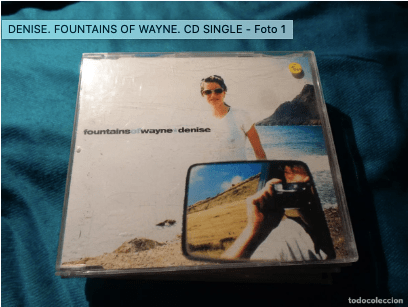
The Auto-Eroticism of Fountains of Wayne’s “Denise” Video

Fountains of Wayne, “Denise”

Fountains of Wayne first hooked me with their masterpiece concept album, Utopia Parkway, an ode to the also-ran early adults who smoked pot in the back of vans, went to coffee-house shows at Barnes & Noble, listened to Korn. The album captures the lives of those who never quite grew up—just self-aware enough to recognize their own stagnation but cushioned by privilege to avoid real consequences. They drift but never crash.

That sense of middle-ground nostalgia should have translated into breakout sales, but somehow it didn’t. Utopia Parkway had all the ingredients: sharp storytelling, airtight hooks. It was clever without being smug, accessible without pandering. And yet, it scattered into fan-boy appreciation rather than mainstream success—perhaps too middle-class to feel urgent, too polished to be rebellious.

The one official video from the album was the sublime “Denise,” a song that never charted outside of the alt list but, in retrospect, prefigured their only real hit, “Stacy’s Mom.” The difference between the two was mostly novelty marketing. “Stacy’s Mom” had a built-in high-concept premise: a teenage boy infatuated with his friend’s mom. “Denise,” by contrast, plays it straight—an impossible longing for an unattainable love object (and her lavender Lexus), a theme that runs through much of FOW’s best work. Both songs hinge on that same core emotional hook, but “Stacy’s Mom” had a music video that played up the comedy and Fast Times lasciviousness in a way that made it easy to package for early-2000s MTV.

And yet, Denise might be the more interesting of the two. The video, at first glance, leans into familiar rock tropes—a foxy love interest, an adoring band, stylized excess. The fact that FOW have two videos where a woman is getting the Flashdance shower treatment makes you wonder if they are fracking the male gaze, and are indeed nice-guy frat rock. But “Denise” quickly subverts this supposition. It’s not that the video muse Denise is too unbelievably hot for the band (though, in reality, she is), and can only be ‘had’ in the form of a teenage boy fantasy of her getting drenched—it’s that she only has eyes for her car, her “lavender Lexus.”

There are shades, lavender shades, of J.G. Ballard’s novel, Crash, in which characters are romantically attracted to car crashes. Denise’s love affair with her Lexus isn’t just a visual gag—it taps into something deeper, a pop-friendly nod to the auto-erotic obsession found in Crash. In “Denise,” the romance is streamlined and sanitized, but the DNA of that fetish remains. It also feels like a sly nod to The Cars, the band Fountains of Wayne most resembles, and who might have been the blueprint for the career they should have had.

J.G. Ballsrd´s Crash

But they didn’t have that career. Fountains of Wayne will forever be, to my mind, the most deserving/least appreciated band of my generation. Their songs, one after the other, are gems of ear toffee, falling just short of anthems and perfect for so many film and TV soundtracks they somehow never landed. They were tailor-made for the angst of suburban summers, for the peculiar youthful restlessness of places like Montclair, Scarsdale, and Winnetka.

Maybe they were just too Upper Middle Class, the survival instinct buried under Enteman’s cookie packaging and Nintendo games. This was before Vampire Weekend made liberal arts slumming cool—or their version of cool. Also, there’s nothing cool about Vampire Weekend.

Ultimately, FOW were smarter than they were dangerous, and you might put their lack of success down to their lack of charisma. They looked like what they were: a pair of nice guys from Williams College who could have just as easily been humanities professors, copyright lawyers, or publishing executives as rock stars. It’s a tough act to pull off. Hence, the mythologizing, sexualized videos that are highly referential to ‘cooler’ art and artists.

All this sounds like I don’t like FOW, but when all is said and done, I identify with them more than any pop artists outside of other New England liberal arts college grads like Elliott Smith. Their world—their sound, their sensibility—is one I know all too well. Maybe that’s why it never quite hit. It wasn’t a fantasy. It was just… familiar.

Video for Fountains of Wayne´s Denise

More on suburban woe in my memoir, Strange as Angels, here, live on PDF.

Or, sample this semi “Denise” inspired Playlist.

Uncategorized

Pin Kode: Ariel Pink’s Picture Me Gone

“Picture Me Gone” video / Ariel Pink

I didn’t think much of Ariel Pink until his triptych of videos from the 4AD-released album pom pom started showing up on YouTube. All directed by Grant Singer, they offered a hook into the artist whose recordings can be challenging. But the lush visuals and narratives of Los Angeles misfits make them hard to turn away from—more arthouse noir films in miniature than music videos. Soon, the songs themselves became the craving.

I think of the video to “Picture Me Gone,” in particular, as a time-release capsule; a slow revelation of greatness, which leaves graffiti on the psychological landscape that only comes clear once you’ve passed it by. It’s easy to dismiss the video, and Pink himself, as a weird outlier until you stop and engage.

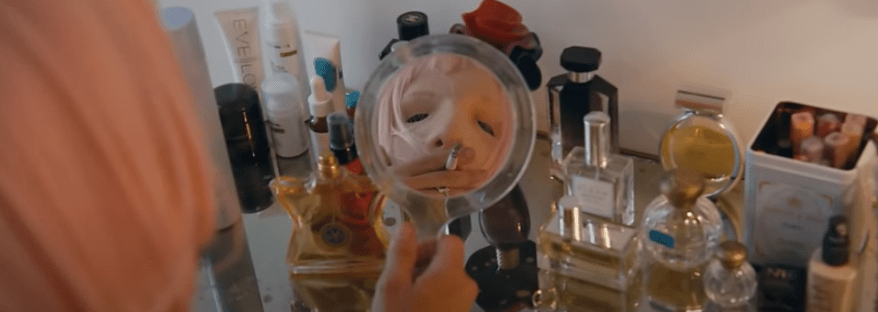
The storyline imagines the lives of three latex-masked loners in Los Angeles, their faces featureless, blank canvases the viewer can project onto. It’s creepy in a Twilight Zone way, both hip and mundane—a reality show of Michael Myers’ urbane relations and their erotic lives. It has an otherworldly quality, a horror movie devoid of overt horror, which is not so different from how Los Angeles actually feels.

The motifs of the uncanny contribute to a work that’s disembodied of meaning but also impossible not to interpret. All at once it might be about gender fluidity, erosion of identity, alienation, abortive attempts at connection, or possibly something entirely different, as the bare latex nipple pointed at the thirsty housecat would imply—an aesthetic I’m calling ‘dark cozy.’

The sunny, atmospheric video saves the song from all the suicide ideation one could bring to the tantalizingly bleak lyrics. Which begs the question: do we want to be saved? Pink will never be a comfort-listen, and the few swoony ballads like “Picture Me Gone” are outliers in his oeuvre. Mediated death and mimetic suicide always have their comforts, and are one reason artists who kill themselves skyrocket in popularity.

But Pink’s not that kind of artist. He is more remote, cloistered, contrary, and unrestrained. He’s a flasher throwing open his overcoat and accosting you with taxidermy badgers, Zippy the Pinhead comic strips, the likeness of Santa Muerte burnt into toast. His vibe is Dadaist, more in the vein of The Fall and Kurt Weill than his stated influences would suggest. Though maybe in his exuberant need to provoke, and to refuse to let you in on the joke, along with his relentless creative outpouring, Kanye West is his closest ally. Like Ye, he does so little to court favor, to be liked, which is in contrast to depressive musicians of his generation—Elliott Smith, for example—whose misery seems to yearn for company, understanding, and empathy.

Like David Lynch, who mined and then introduced us to our common dreamscapes, Pink doesn’t drape his work in melancholy. What’s beneath it all is a sincerity that belies the irony one expects of artists of his generation. It’s the unguarded selfie posted just to know somebody is looking, even if it’s only the camera, our pictures increasingly a stand-in for our personalities. Maybe imagining losing your iPhone is a kind of suicide ideation.

According to Pink, the song is about the modern condition of having all your memories locked inside a smartphone, without analog versions to preserve them. If you die without sharing your passwords, what remains of you? What if your device is lost—“down in Mexico”? But there’s something more personal at work here. Pink’s own past in Mexico—sent to live with relatives to escape high school bullying, and losing his virginity to a prostitute at thirteen—adds another layer. The song carries echoes of an ’80s sex comedy about loss of innocence as much as it critiques the fragility of digital memory.

The lyrics “Picture me gone / Picture me gone/ Picture me not” present the audience with a nifty zen koan, as you can’t picture something that’s not there; an Instagram account curating the void. Yet he’s not requesting that the listener contemplate this; he’s commanding them. Fittingly, Pink was canceled by people who mistook his artistic outsider tendencies as political affinities and then felt betrayed when this proved wrong. Moreover, the “Picture Me Gone” video and equally pathos-filled “Dayzed Inn Daydreams” come and go from YouTube, so like their creator. Pink’s mode is to be missed, to be present when not there. Pink asks the question: without our selfies, our social media accounts, do we exist at all, and what will be remembered of us when they are deactivated or locked? Pics or it didn’t happen. But what if the pics disappear as well?

Ariel Pink, “Picture Me Gone”

Picture Me Gone playlist

Robert Smith and all the undead 80s, here in my memoir Strange as Angels